Fuel for a sub-2-hour marathon
On 12 October 2019 in Vienna, Eliud Kipchoge ran the marathon distance, 42.2 km, in 1:59:40. That is 4:35 per mile, about 2:51 per kilometre, held for two hours. He had Olympic-level pacers, a prototype carbon-plated Nike shoe that has since been banned, and a course where surface, elevation and wind were managed as carefully as the pacing. Because of that help the time did not count as a world record (the official mark at the time was his own 2:01:39 from 2018), and it was never meant to. Vienna was about finding out whether the barrier was real. Training, kilometres and genes got him to the line; everything else was engineered, including what he ate and drank. We cannot tell you much about ground-reaction forces, but we do know fuel.
Eating is training
GU Energy Labs, the Berkeley company that makes the gels we stock, builds every race plan around one idea: eating is training. Practising your race nutrition matters as much as the long runs and the strength work. Your body adapts to stress, and your digestive system is no exception.
What race pace does to your gut
Between 30 and 50 per cent of endurance athletes run into gastrointestinal trouble during competition (Jeukendrup, 2017), and the harder and longer you go, the more likely it is. For Kipchoge, a rebelling stomach at 35 km was the difference between 1:59:59 and 2:00:01. Here is what a gut is up against at that effort:
- Less blood flow to the gut, because the working muscles take it
- Slower gastric emptying, so food waits longer before it is absorbed
- High concentrations of simple sugars
- Too much fat, fibre or protein in the pre-race meal
- Dehydration
- Too much caffeine
- Over-fuelling: too many carbs or calories in one hit
- Stress and nerves
The good news is that all of this is trainable. Kipchoge's team will have rehearsed every sip long before Vienna. Most GI problems come down to practising your strategy until it is boring, and using the right nutrients in the right form at the right time. Our guide to training your gut has the how.
Not all carbs are equal: the 90 g an hour equation
Your body stores carbohydrate as glycogen in the liver and muscles, and the tank is small: about 1,600–2,000 calories' worth, depending on diet and body size. At 2:51 per kilometre that runs low long before the finish unless it is topped up on the move.
For years the ceiling was thought to be 60 g of carbohydrate an hour, roughly 1 g a minute; feed an athlete more and they could not use it. But those studies used glucose alone. Glucose crosses the small intestine on a specific transporter that saturates at about 60 g an hour, and beyond that the queue just gets longer.
Fructose uses a different, non-competing transporter that lets through about 30 g an hour. Think of a toll plaza: glucose is stuck in the cash lanes while fructose has its own FASTag lane. Combine the two, 60 g of glucose plus 30 g of fructose, and peak carbohydrate oxidation rises to about 90 g an hour. More carbs an hour means more calories, which means more energy for longer.
Glucose also hits fast, with a high-glycaemic response, while fructose is absorbed and metabolised more slowly for a longer release. That quick-plus-steady pairing is why every gel we sell uses maltodextrin and fructose rather than a single sugar.
Osmolality: how fast fuel leaves the stomach
As little as 2 per cent dehydration can impair performance, and over two hours that alone could have sunk the attempt. The variable most people never think about is osmolality, the number of particles dissolved in a drink: the higher it is, the slower the stomach empties and the longer fluid and fuel take to reach the blood. Hypotonic drinks, less concentrated than body fluids, leave the stomach quickly.
GU's answer for this kind of effort was its Roctane drink mix, formulated to stay hypotonic (around 225 mOsm against roughly 300 mOsm for body fluids) while still delivering 250 calories. The trick is maltodextrin: long chains of glucose linked like the coaches of a train. It delivers glucose fast but, as one big molecule, adds far fewer particles than free glucose would, so osmolality stays low and the risk of GI distress drops with it.
We sell the gels, not the drink mix, but the same maltodextrin is in every sachet; wash one down with a few mouthfuls of water and it sits easily.
The supporting cast
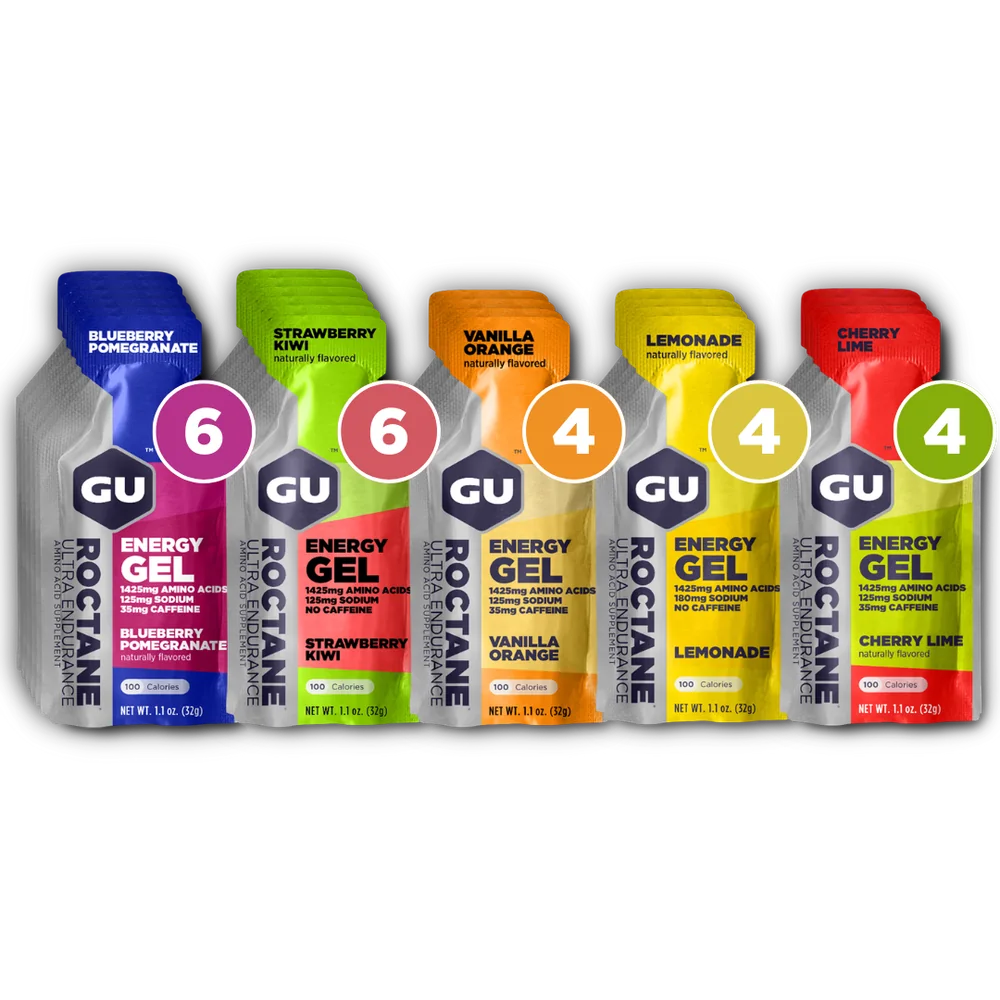
Carbohydrate is the headline, but the drink mix carried more, and Roctane Energy Gel carries the same list in sachet form (caffeine in some flavours, none in others).
- BCAAs. A secondary fuel, supplying up to about 10 per cent of energy needs to hard-working muscles during prolonged exercise. They also limit muscle protein breakdown, support recovery and may take the edge off mental fatigue.
- Taurine. Raises cellular excitability, which in heart muscle means more forceful contractions and more blood pushed out per beat. Levels fall during long, intense efforts, so topping up helps maintain stroke volume and oxygen delivery.
- Beta-alanine. Raises muscle carnosine, which buffers the hydrogen ions and lactic acid that build up at high intensity. That delays local muscle fatigue, which for a sub-2 attempt means one thing: the final kick.
- Caffeine. A long-established endurance aid: sharper focus, delayed fatigue, a duller perception of pain and effort, and more fat burned, sparing glycogen for later.
- Sodium. The main electrolyte lost in sweat, essential for fluid balance and plasma volume. It also makes you want to keep drinking, which on a humid morning in Mumbai or Hyderabad is half the battle.
Borrow the plan, not the pace
- Rehearse race-day fuel in training, at race intensity, until it is boring.
- Use a glucose-plus-fructose source so you can absorb up to 90 g of carbohydrate an hour instead of 60.
- Take it in small, regular servings with water rather than one big hit.
- Test caffeine in training, and put sodium back when it is hot and humid.
Sub-2, or just sub-4
Very few of us will ever need 90 g an hour at 2:51 per kilometre. But the components are the same whether the goal is 1:59, a personal best in Delhi or a first finish in Bengaluru: multiple carbohydrate sources, a trained gut, fluid that leaves the stomach quickly, and amino acids and electrolytes to keep the engine turning. For a race-length plan, read our marathon gel strategy; for the Vienna ingredient list in a sachet, start with Roctane Energy Gel.
These statements have not been evaluated by a regulatory authority. This product is not intended to diagnose, treat, cure or prevent any disease.